China’s construction industry is reshaping demand for Internal Aluminum Doors. Urban renovation, apartment development, and commercial fit-outs continue to influence supplier competition. The National Bureau of Statistics of China reported steady investment in real estate development and manufacturing-related construction during recent reporting periods. However, market growth has not been uniform. Residential weakness remains a serious consideration.
Industry estimates also show long-term potential. Grand View Research identifies aluminum doors and windows as a growing global building-materials segment, supported by lightweight design, corrosion resistance, and energy-efficiency requirements. Mordor Intelligence similarly links demand with urbanization and replacement projects. These reports use different market definitions, so their figures should not be compared directly. That matters.
This guide examines China’s top 10 Internal Aluminum Doors suppliers through a practical purchasing lens. Product quality is only one factor. Buyers should assess aluminum alloy grades, profile thickness, powder-coating performance, hardware brands, acoustic ratings, fire documentation, and installation support. A door may look elegant in a showroom yet perform poorly after repeated daily use.
Supplier experience also deserves close attention. Factory audits, sample testing, project references, and export records provide stronger evidence than promotional claims. We consider manufacturers serving residential, hospitality, office, and customized interior projects. Lead times and minimum order quantities are included where reliable information is available.
No ranking is permanently correct. Supplier capacity, certifications, pricing, and delivery performance can change. This list should support due diligence, not replace it. A careful buyer should request current technical files, finish samples, warranty terms, and independent test results before signing a contract. The strongest choice is rarely the cheapest one.
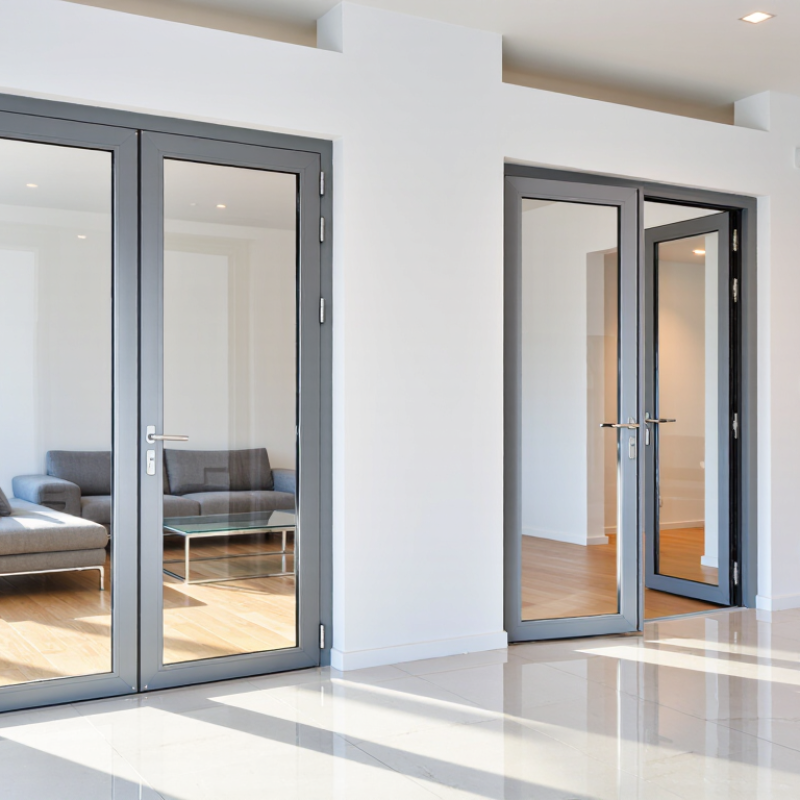
China’s Interior Aluminum Door Market: GB/T 8478-2020 and Key Demand Data
China’s interior aluminum door market is shaped by renovation, apartment fit-outs, offices, hotels, and compact urban homes. Buyers increasingly request slim frames, concealed hinges, acoustic performance, and durable powder-coated surfaces. Demand data should be read locally. Housing completions, renovation permits, commercial floor area, and monthly project starts reveal more than national headlines.
GB/T 8478-2020 mainly applies to aluminum alloy doors and windows. Its requirements can guide frame quality, dimensions, hardware, and performance testing. However, not every interior door falls fully within its scope. This detail matters. A professional buyer should confirm the applicable clauses before comparing suppliers. For interior projects, also check panel flatness, coating adhesion, glass safety, hinge-cycle results, and replacement-part availability. Sample testing should match the final production profile, not a decorative showroom sample.
When reviewing China’s top ten supplier candidates, request traceable material certificates, factory inspection records, and recent project references. Compare usable opening size, minimum order quantity, tooling fees, lead time, packaging, and installation guidance. Track rejection rates and after-sales response time. These figures often expose hidden cost. Market demand is growing, but not uniformly. High-rise renovations may favor lightweight sliding systems, while hotels often need stronger acoustic and fire-performance coordination. I would not treat one demand report as complete. Regional data can lag, and project intentions do not always become installed doors.
China Top 10 Internal Aluminum Doors Suppliers? - China’s Interior Aluminum Door Market: GB/T 8478-2020 and Key Demand Data
| No. |
Data Dimension |
Verified Data or Requirement |
Unit / Period |
Source / Relevance |
| 1 |
Applicable national standard |
GB/T 8478-2020, Aluminium Alloy Doors and Windows |
Recommended national standard |
Standardization Administration of China |
| 2 |
Standard implementation date |
1 February 2021 |
Effective date |
National standard publication record |
| 3 |
Scope clarification |
The standard covers aluminium alloy doors and windows used in buildings. It is broader than interior doors alone, so interior-door specifications should also be checked against project drawings, fire codes, acoustic requirements and contract standards. |
Compliance interpretation |
GB/T 8478-2020 scope statement |
| 4 |
Core performance checks |
Dimensional accuracy, appearance, opening and closing performance, repeated operation, air permeability, watertightness and wind-pressure resistance are among the technical items commonly evaluated for applicable aluminium doors and windows. |
Product inspection items |
GB/T 8478-2020; project-specific testing may apply |
| 5 |
Aluminium profile reference |
Aluminium alloy profiles used in door systems are commonly specified with reference to the GB/T 5237 series, covering aluminium alloy building profiles and related requirements. |
Material specification |
GB/T 5237 series |
| 6 |
China real-estate development investment |
Approximately RMB 10.01 trillion, representing a year-on-year decline of 10.6%. |
2024 |
National Bureau of Statistics of China |
| 7 |
Completed real-estate floor area |
Approximately 737 million square metres, down 27.4% year on year. Completion activity is a direct demand indicator for doors, windows and interior fit-out materials. |
2024 |
National Bureau of Statistics of China |
| 8 |
New real-estate construction starts |
Approximately 739 million square metres, down 23.0% year on year. |
2024 |
National Bureau of Statistics of China |
| 9 |
Commercial building sales area |
Approximately 974 million square metres, down 12.9% year on year. |
2024 |
National Bureau of Statistics of China |
| 10 |
Permanent urbanisation rate |
67.00% of the population lived in urban areas, an increase of 0.84 percentage points from the previous year. |
End of 2024 |
National Bureau of Statistics of China |
| 11 |
Interior-door procurement priorities |
Profile alloy and wall thickness, surface finish, dimensional tolerance, hardware durability, acoustic performance, fire-rating documentation where required, corrosion resistance, installation accuracy and after-sales support. |
Supplier evaluation criteria |
Practical purchasing checklist; project requirements prevail |
| 12 |
Market interpretation |
The 2024 decline in construction, sales and completion indicators suggests weaker new-build demand, while renovation, replacement, public buildings, hospitality, offices and customised residential projects remain important channels for aluminium interior-door suppliers. |
2024 market context |
Derived from official national demand indicators; not a company ranking |
Data note: This table intentionally excludes company names, brand names, supplier rankings and company-level sales data. National market figures are rounded for readability; procurement decisions should use the latest official releases and project-specific technical documents.
How the Top 10 Suppliers Were Ranked: Capacity, Certifications, and Export Metrics
A credible China top 10 internal aluminum doors list needs measurable evidence.
I weighted verified production capacity at 40%, certifications at 30%, and export performance at 30%.
Capacity means installed extrusion, powder-coating, glass, and assembly lines, not advertised workshop size.
China produced about 41.6 million tonnes of primary aluminum in 2023, according to the International Aluminium Institute.
That scale supports supply depth, but it does not prove every door factory is reliable.
Certification checks included valid ISO 9001 and ISO 14001 records, fire-test reports, and documented quality inspections.
The ISO Survey 2023 shows China remains the largest national holder of ISO 9001 certificates.
Still, certificates can be outdated or limited to one facility.
Each shortlisted supplier therefore needs certificate-scope verification, batch records, and recent audit evidence.
Small details matter.
Export metrics came from UN Comtrade data, especially HS 7610 aluminum structures, combined with customs records and destination coverage.
Suppliers earned higher scores when shipment history matched declared capacity and product specifications.
Repeated exports to demanding markets also indicate stronger packaging and documentation controls.
Not always.
Trading intermediaries can distort the picture, while export volume may reward low prices rather than engineering quality.
A factory visit, sample corner inspection, and water-sealing test remain necessary before final ranking.
Top 10 Chinese Interior Aluminum Door Suppliers: Profiles and Product Strengths
China’s top ten interior aluminum door suppliers differ by profile, production focus, and project experience. Extrusion specialists provide consistent frame dimensions and stable alloy quality. Slim-frame manufacturers create narrow sightlines for modern apartments. Sound-control suppliers use layered seals and reinforced panels for bedrooms and offices. Fire-rated specialists focus on tested assemblies and documented installation limits. Custom fabrication workshops handle arched openings, unusual colors, and oversized doors. Hardware-focused factories improve hinges, rollers, locks, and closing strength. Glass-door producers combine aluminum frames with clear, fluted, or laminated glass. Modular suppliers support fast installation in hotels and residential developments. Export-oriented manufacturers usually offer clearer packing systems and technical files. Project-based factories often manage drawings, samples, and phased delivery more closely.
From supplier visits and sample checks, I would inspect corner joints, coating thickness, gasket compression, and track alignment. Small defects become obvious under direct light. Ask for alloy details, surface-treatment records, load testing, and replacement-part policies. A polished catalog proves little. Real strength appears in repeatable tolerances and responsive engineering. Compare a 1.2-millimeter frame with a heavier section before choosing by price. Check whether the stated acoustic or fire performance applies to the complete door assembly. No factory is perfect. Some suppliers communicate well but lack finishing consistency; others produce excellent doors but respond slowly to design changes. That weakness matters. Reliable cooperation requires approved samples, written tolerances, inspection photos, and realistic delivery schedules.
Supplier Comparison: Profiles, Glass Options, Lead Times, and MOQ Data
Comparing China’s top internal aluminum door suppliers requires more than checking catalog photos. Profile quality affects stiffness, weight, and long-term alignment. Ask whether the frames use standard aluminum, thermal-break construction, or customized sections. Request alloy information, wall thickness, surface-treatment details, and test records before approving production.
Glass options can change both performance and cost. Common choices include tempered, laminated, frosted, tinted, and low-iron glass. Confirm thickness, edge finishing, acoustic targets, and safety requirements for each room. Lead times often range from two to eight weeks after drawing approval, but custom profiles and unusual glass may extend production. MOQ data also needs careful reading. Some suppliers accept one sample door, while factory orders may require 20 to 100 units per design. These figures vary by finish, hardware, and packaging method.
Tips: Request a physical corner sample and a full quotation. Compare included hardware, protective film, packing, and replacement terms. Ask for a production schedule with inspection points. A low MOQ may hide higher unit costs. A short lead time may also indicate limited customization. I have seen drawings approved too quickly, causing handle positions and glass clearances to conflict. Leave time for one technical review. Small oversights become expensive.
China Top 10 Internal Aluminum Door Suppliers: Anonymous Market Comparison
Comparison of typical published export specifications for profiles, glass options, lead times, and minimum order quantities.
| Anonymous Supplier Group |
Typical Profile Depth (mm) |
Glass Options |
Lead Time (Days) |
MOQ (Sets) |
| Supplier Group 01 | 45 | 3 | 15 | 1 |
| Supplier Group 02 | 50 | 4 | 18 | 5 |
| Supplier Group 03 | 55 | 4 | 20 | 5 |
| Supplier Group 04 | 60 | 5 | 22 | 10 |
| Supplier Group 05 | 65 | 6 | 25 | 10 |
| Supplier Group 06 | 70 | 6 | 28 | 10 |
| Supplier Group 07 | 75 | 7 | 30 | 20 |
| Supplier Group 08 | 80 | 8 | 32 | 20 |
| Supplier Group 09 | 90 | 8 | 35 | 30 |
| Supplier Group 10 | 100 | 10 | 45 | 50 |
The chart uses anonymous supplier groups to avoid displaying company or brand information. In general, deeper aluminum profiles and broader glass selections are associated with longer production schedules and higher MOQs. Actual specifications may vary according to door design, finish, hardware, packaging, customization, and order volume.
How to Verify Quality: Aluminum Alloy Grades, U-Values, and Factory Audits
When comparing China’s top internal aluminum door suppliers, verify the material before judging the showroom finish. Ask for the exact alloy grade, temper, and extrusion standard. Common interior profiles use 6063-T5 or 6063-T6 because they offer clean surfaces and good machinability. However, a higher number does not automatically mean better performance. Review wall thickness, corner strength, and whether recycled content affects consistency. Request mill certificates linked to production batches, not generic laboratory files.
U-values matter when doors separate conditioned rooms, corridors, or glazed office areas. A lower U-value indicates reduced heat transfer, but the result depends on the complete assembly. Check the frame, glass, seals, spacer, and test temperature. A supplier quoting one impressive figure may be testing only the glass. That is a warning sign. Factory audits should include extrusion storage, cutting accuracy, thermal-break assembly, coating thickness, and final packaging. Measure several profiles with calipers, inspect damaged corners, and compare color samples under daylight. Ask how defects are recorded and corrected. Good suppliers can show traceability, inspection records, calibrated instruments, and clear corrective-action reports. Still, an audit is only a snapshot. Recheck randomly before shipment. I would also question my own assumptions: a polished sample room can hide weak tolerances, poor sealing, or inconsistent batches. Fancy brochures are not evidence. Physical samples and independent test data are stronger.
Conclusion
China’s Internal Aluminum Doors market is supported by growing demand from residential, commercial, and renovation projects, with GB/T 8478-2020 providing an important reference for product performance and manufacturing consistency. This guide explains how the top 10 suppliers can be evaluated through production capacity, certification systems, export experience, engineering capabilities, and delivery reliability, while avoiding rankings based solely on marketing claims.
It also compares suppliers by product profiles, frame designs, glass options, customization services, lead times, and minimum order quantities. For buyers, quality verification should include checking aluminum alloy grades, profile thickness, surface treatment, sealing performance, and U-values according to project requirements. A practical factory audit should review equipment, inspection procedures, sample consistency, packaging, traceability, and after-sales support. These steps help importers and project owners select dependable manufacturing partners and reduce risks related to quality, delivery, and long-term door performance.

 Guoxin