Global buyers are no longer choosing Aluminium Frames by appearance alone. They are comparing thermal performance, recycled content, corrosion resistance, certification, and long-term maintenance. The decision becomes more demanding across climates. A frame installed beside a humid coastline faces different risks from one used in a cold continental city.
The International Aluminium Institute reports that aluminium demand could reach nearly 120 million tonnes annually by 2030. Its recycling data also shows that remelting aluminium uses about 5% of the energy required for primary production. These figures make recycled content commercially important, but they do not prove every frame is sustainable. Buyers should request alloy grades, recycled-content evidence, environmental product declarations, and test results. Details matter.
Gerd Götz, former Director General of European Aluminium, described aluminium as “a permanent material.” That principle supports durable frame systems, provided manufacturers control coatings, thermal breaks, drainage, and fabrication quality. The World Aluminium Life Cycle Inventory also highlights the need for transparent, comparable environmental data across the supply chain.
Top Aluminium Frames should therefore be judged as engineered systems, not simple building components. Look for tested U-values, air-tightness results, water resistance, wind-load performance, and clear warranty terms. Hardware compatibility matters too. So does local installation expertise.
The market is not perfectly transparent. Some claims remain difficult to verify. That weakness deserves attention. A low-carbon label cannot replace independent testing or traceable material records. For global buyers, the strongest choice balances design flexibility, verified performance, supply reliability, and responsible sourcing. Cost still matters. But the cheapest frame may become expensive when condensation, corrosion, or replacement appears later.
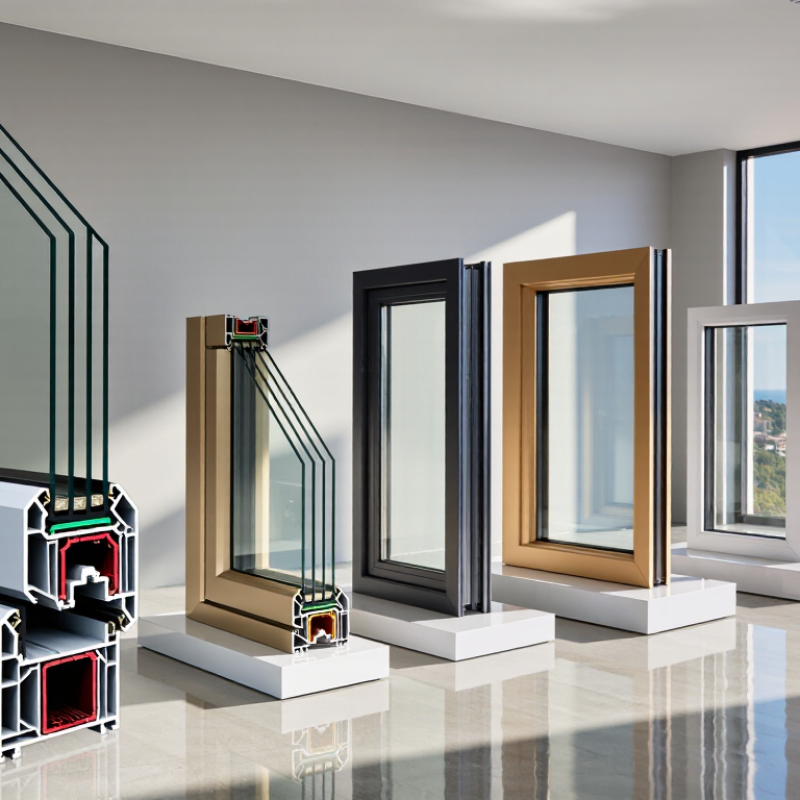
A high-quality aluminium frame begins with verified material, not a polished photograph. The International Aluminium Institute reports that recycled aluminium can require up to 95% less energy than primary metal. That advantage matters, but recycled content must remain traceable.
Global buyers should request alloy, temper, and batch information before approving samples. Common architectural alloys, such as 6063, offer useful extrusion performance and clean surface finishes. However, alloy choice alone does not prove durability. Test records should cover tensile strength, dimensional tolerance, coating thickness, and corrosion resistance. Standards such as EN 755-2, ISO 2360, and ISO 9227 provide useful reference points. Details matter.
The USGS Mineral Commodity Summaries 2024 estimates global primary aluminium production at about 70 million metric tons in 2023. Such scale increases sourcing options, but also increases documentation risk. A reliable supplier should provide mill certificates, inspection records, and clear origin data. Inspect the corners, drainage channels, fasteners, and gasket compression. These small areas often reveal weak engineering. No frame is perfect. Even strong specifications can fail when installation is careless or exposure conditions change. A coastal project may need better coating preparation than an indoor partition. Buyers should challenge vague claims, compare independent test results, and verify whether performance data matches the finished frame, not only the raw profile.
Strength is one important indicator when comparing aluminium frame materials. The chart shows commonly specified minimum tensile and yield strength values for widely used extrusion alloys and tempers. High-quality frames should also combine suitable corrosion resistance, accurate dimensional tolerances, consistent surface treatment, reliable weld or joint design, and traceable quality documentation. Values should be verified against the applicable EN or ASTM specification and the supplier’s inspection certificate.
Global buyers comparing aluminium frames should match alloy, temper, profile geometry, and finish to the working environment. In site inspections, 6063-T5 and 6063-T6 remain practical choices for windows, partitions, light machine guards, and retail structures. They extrude cleanly and accept anodizing well. For heavier supports, 6061 offers higher strength, although it can be less forgiving during complex extrusion. Verify wall thickness, straightness, and corner radii before approving a drawing. Small profile changes can alter assembly time.
Thermal-break profiles suit exterior doors and façades where indoor comfort matters. Polyamide separators reduce heat transfer, but weak seals can defeat the design. T-slot profiles work well for adjustable workstations, conveyors, and laboratory frames. Box sections provide better bending resistance for long spans. Angle and U-channels are useful for covers, trays, and simple brackets. Choose powder coating for color range and abrasion resistance. Choose anodizing when a hard, metallic surface is preferred. Fit matters.
Global sourcing also requires practical verification. Request alloy and temper certificates, dimensional tolerances, coating thickness records, and corrosion-test results. Check whether fasteners match the environment. Stainless steel can still cause staining near aluminium without isolation. I once accepted a visually perfect frame that flexed under a modest load. The profile was too shallow. That mistake taught me to review load tables, joint stiffness, drainage, and installation tools together. Test a sample assembly. Drawings can hide awkward access.
Global buyers should compare aluminium frames by load performance, not appearance alone. A thick profile may look strong, yet poor alloy selection can reduce reliability. Check the alloy grade, wall thickness, joint design, and welding quality. Alloys used for structural frames, such as 6061 or 6063, offer different balances of strength and formability. Ask for test reports, dimensional drawings, and batch traceability before placing a large order.
Strength is only one part of the decision. A lighter frame can reduce shipping costs and simplify installation, but excessive weight reduction may weaken corners. Measure deflection under a stated load, rather than trusting a general strength claim. Field inspections often find movement around fasteners first. Reinforced joints matter. So does accurate machining. Small gaps can collect water and accelerate corrosion.
Durability depends on the environment and maintenance plan. Coastal projects need strong surface protection and careful drainage design. Compare anodizing or powder coating thickness, salt-spray results, and resistance to ultraviolet exposure. Inspect cut edges and weld zones closely. These areas often fail before the main profile. No test predicts every site condition. That limitation deserves honest discussion. I would also request samples before approval, because a polished catalog can hide rough finishes, inconsistent tolerances, or awkward assembly details.
For global buyers, aluminium frame quality begins with verifiable manufacturing standards. Ask which alloy is used, such as 6063-T5 or 6061-T6. The supplier should provide mill certificates, chemical composition, and tensile-strength results. Check whether production follows EN 755 or EN 12020 for profiles and dimensional tolerances. These details affect corner joints, sliding performance, and long-term stability.
Tips: Request an ISO 9001 certificate with a valid certification body. For environmental control, ISO 14001 can show stronger process management. Powder-coated frames should include coating thickness records and adhesion tests. In coastal projects, ask for corrosion testing and a clear warranty. Do not accept a certificate image alone. Verify its number, scope, and expiry date independently.
Factory inspection adds useful evidence. Review extrusion temperatures, cutting accuracy, drainage holes, and hardware installation. Batch numbers should connect raw aluminium to finished frames. Certificates for glass, sealants, and fire performance may also be required by the destination market. A CE mark, where applicable, does not replace product-specific testing or local compliance checks. Even a careful checklist has limits. Small suppliers may maintain excellent workmanship but weak documentation. That gap deserves a sample inspection, not an automatic rejection. Examine one frame closely, including its gasket fit, corner alignment, and coating consistency.
| Frame Type or Buyer Checkpoint | Typical Specification or Benchmark | Relevant Standard or Certification | What the Buyer Should Verify | Recommended Evidence |
|---|---|---|---|---|
| Thermally broken window and door frames | Aluminium profiles separated by a low-conductivity polyamide thermal barrier; suitable for energy-conscious residential and commercial buildings. | EN 14024 for metal thermal-barrier components; EN 14351-1 for external windows and pedestrian doorsets where applicable. | Thermal transmittance, air permeability, watertightness, wind resistance, barrier width, and corner-joint quality. | System test reports, declared U-values, thermal-barrier test results, and production inspection records. |
| Non-thermally broken frames | Single aluminium profile construction; commonly used for interior partitions, mild climates, and applications where thermal performance is not the primary requirement. | EN 755 series, EN 12020 series, ASTM B221/B221M, or the applicable national product specification. | Profile geometry, wall thickness, straightness, surface condition, load capacity, and resistance to corrosion. | Mill certificates, dimensional inspection reports, alloy and temper certificates, and sample approval records. |
| Curtain wall frames | Mullion-and-transom systems designed to transfer wind loads while accommodating movement, glazing loads, drainage, and building tolerances. | EN 13830 for curtain walling; ASTM E330/E330M for structural performance where specified by the project. | Design wind pressure, deflection limits, water penetration, air leakage, drainage, thermal movement, and anchorage design. | Project-specific calculations, laboratory test reports, approved shop drawings, and installation method statements. |
| Sliding and lift-and-slide frames | Large opening systems requiring rigid profiles, accurately aligned tracks, durable rollers, reliable seals, and controlled drainage. | EN 14351-1 for external windows and doorsets; applicable national air, water, wind, and operation-cycle standards. | Operating force, cycle durability, sash deflection, locking security, water drainage, air leakage, and hardware compatibility. | Cycle-test reports, performance classifications, hardware specifications, and pre-shipment functional inspection results. |
| Aluminium alloy and temper | 6063 alloys are widely used for architectural extrusions; the selected temper must match the required strength, formability, and finish. | EN 573 for chemical composition, EN 755-2 for mechanical properties, and ASTM B221/B221M where ASTM material is specified. | Alloy designation, temper condition, chemical composition, tensile strength, yield strength, and elongation. | Traceable material certificate linked to the production batch and independent laboratory verification when required. |
| Extrusion dimensions and tolerances | Profile tolerances must be controlled for wall thickness, cross-section, straightness, twist, length, and corner geometry. | EN 755-9 for general extrusion tolerances; EN 12020-2 for precision extruded profiles. | Whether the tolerance class matches the design drawings, glazing system, gaskets, hardware, and assembly method. | Approved profile drawings, calibrated measurement records, first-article inspection, and routine sampling plans. |
| Powder-coated surface finish | Coating thickness, adhesion, colour consistency, weather resistance, and pretreatment quality should be controlled across every batch. | ISO 12944 for corrosion-protection environments; ISO 2409 for cross-cut adhesion; ISO 2813 for gloss measurement. | Specified coating system, film thickness, adhesion rating, colour tolerance, gloss level, pretreatment, and corrosion resistance. | Coating batch records, thickness readings, adhesion test results, colour comparison panels, and accelerated corrosion test reports where required. |
| Anodized surface finish | Electrochemically formed oxide coating offering decorative appearance and improved surface durability; colour variation should be managed by batch control. | ISO 7599 for anodizing of aluminium; ISO 2360 for non-conductive coating thickness measurement. | Anodic layer thickness, sealing quality, colour uniformity, surface defects, and suitability for the exposure environment. | Anodizing process records, thickness measurements, sealing test results, approved colour samples, and batch traceability. |
| Quality management system | Documented control of design, purchasing, extrusion, fabrication, finishing, inspection, nonconformities, and corrective action. | ISO 9001 certification from an accredited certification body. | Certification scope, manufacturing-site address, validity period, audit status, and whether the scope covers aluminium frame production. | Current certificate, accreditation details, quality manual extracts, inspection plan, and corrective-action records. |
| Environmental management | Controls for energy use, waste, wastewater, chemicals, emissions, aluminium scrap, and environmental legal compliance. | ISO 14001 certification; ISO 14025 and EN 15804 may support environmental product declarations where applicable. | Actual certification scope, recycled-content claims, life-cycle data, waste records, and environmental impact boundaries. | Valid ISO 14001 certificate, verified environmental product declaration, recycled-content evidence, and waste-transfer records. |
| Worker health and safety | Formal controls for machinery, chemicals, heat, noise, lifting, personal protective equipment, and emergency response. | ISO 45001 certification. | Certification scope, site coverage, incident controls, chemical handling procedures, and contractor safety requirements. | Valid certificate, audit summary, risk assessments, training records, and safety performance documentation. |
| Product conformity and market access | The frame or complete doorset/window must meet the legal requirements of the destination market and the project specification. | CE marking and Declaration of Performance may apply to construction products covered by applicable European harmonised requirements; other markets may require local conformity schemes. | Correct product classification, declared performance, notified or approved assessment route, and consistency of production controls. | Declaration of Performance, test or assessment reports, factory production control records, and destination-market compliance documents. |
| Factory production control and traceability | Every frame should be traceable from raw aluminium batch through fabrication, finishing, inspection, packaging, and shipment. | ISO 9001 principles and the factory-production-control requirements of the applicable product standard. | Batch coding, inspection frequency, calibration of measuring equipment, nonconforming-product control, and retention of records. | Serial or batch records, inspection and test plans, calibration certificates, packing lists, and pre-shipment inspection reports. |
Global buyers evaluating aluminium frames need more than a low quotation. In supplier audits, I look for alloy grades, temper records, dimensional reports, and coating samples. Ask for recent inspection photos. Better still, request a small production sample before approving a large order. A capable supplier explains tolerances in plain language. Vague answers are costly warning signs. Check factory capacity, tooling ownership, quality staff, and export packaging experience. Certificates help, but they do not replace physical evidence. That distinction matters.
Compare costs line by line, not through unit price alone. Include extrusion, machining, surface treatment, packing, documentation, inland transport, insurance, duties, and port charges. Confirm whether the quote uses kilograms, pieces, or finished assemblies. Small differences in wall thickness can change strength and freight weight. Ask about minimum order quantities and replacement policies for damaged parts. Payment terms deserve equal attention. A cheaper offer may require faster payment and provide weaker protection. I have seen buyers overlook tooling fees until the first invoice arrived. That mistake is avoidable, although not always obvious.
Shipping plans should match the frame’s length, volume, and destination infrastructure. Long profiles need rigid crates, corner protection, moisture control, and clear handling marks. Confirm carton dimensions before booking space. Request a packing list with piece counts and net and gross weights. Compare sea, rail, and air options when schedules are tight. Verify cut-off dates, transit estimates, customs documents, and final-mile delivery limits. Freight calculators can mislead when oversized cargo is reclassified. Build a reasonable buffer. Delays happen. A reliable supplier reports changes early and keeps records that both sides can check.
6063-T5 and 6063-T6 suit windows, partitions, light guards, and retail structures. They extrude smoothly and accept anodizing well.
Choose 6061 for heavier supports and higher loads. Complex shapes may extrude less easily. Check the supplier’s strength data.
Box sections resist bending better across long spans. T-slot profiles suit adjustable workstations, conveyors, and laboratory frames.
Yes. Polyamide separators reduce heat transfer and improve indoor comfort. Weak gaskets can still undermine the whole design.
Powder coating offers many colors and good abrasion resistance. Anodizing provides a hard, metallic surface. Surface preference matters.
Check wall thickness, straightness, corner radii, drainage, and joint stiffness. Small profile changes can increase assembly time.
Request alloy certificates, temper records, chemical composition, tensile results, tolerances, and coating-thickness records. Verify certificate numbers independently.
Inspect one sample frame closely. Check gasket fit, corner alignment, coating consistency, fasteners, and drainage holes. Drawings hide awkward access.
A shallow profile may flex under a modest load, even when it looks perfect. I learned to review load tables and joints together.
Choosing the right Aluminium Frames requires global buyers to evaluate quality, application needs, performance, compliance, and supply reliability. A high-quality frame should offer precise dimensions, consistent surface treatment, secure connections, and resistance to corrosion, wear, and environmental changes. Different projects may require various aluminium alloys, profile shapes, wall thicknesses, and modular designs, depending on whether the frames are intended for construction, equipment, interiors, transportation, or industrial use.
Buyers should compare strength, weight, load capacity, service life, and maintenance requirements rather than focusing only on the lowest price. Manufacturing standards, quality-control procedures, material testing, and relevant certifications can help verify consistency and safety. Supplier evaluation should also include production capacity, customization support, communication, packaging, lead times, shipping methods, import documentation, and total delivered cost. A complete assessment enables buyers to select Aluminium Frames that balance performance, durability, budget, and dependable international delivery.

Guoxin